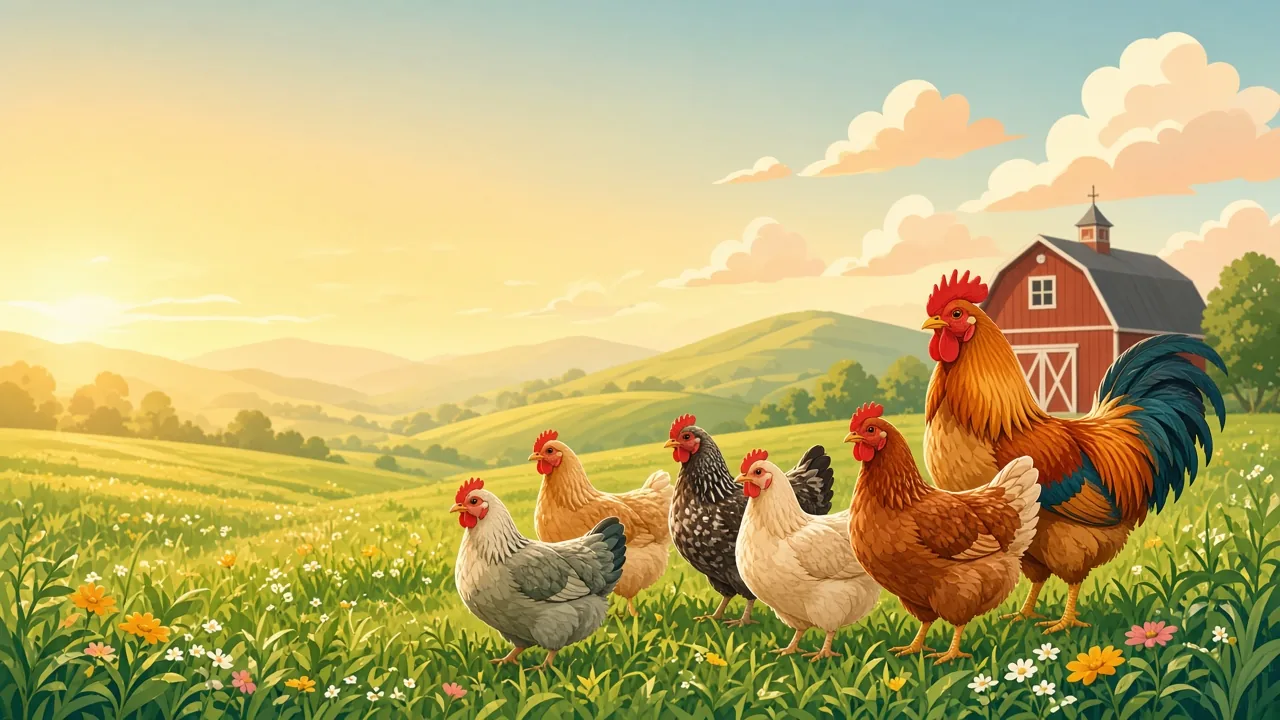
A flock of hens and a rooster in a sunlit meadow in front of a red barn.

Est. 2019 · Independent & ad-supported

The chicken is the most underestimated animal on Earth.

Thirty distinct calls. Ultraviolet vision. A face-recognition memory that rivals a toddler's. We spend our days documenting what Gallus gallus domesticus is actually capable of — and designing arcade games in its honour.

Free to read, no account, no paywall — ever.

26bn Chickens alive right now — more than any other bird
30+ Distinct vocalisations catalogued by researchers
100+ Individual faces a single hen can tell apart
3,500 yrs Since domestication began in South-East Asia

Feathered facts

Six things about chickens that sound made up

They are not made up. Each one comes from published behavioural or veterinary research — we have listed our reading in the sources note.

They see colours you never will

Humans have three types of cone cell. Chickens have four, plus a double cone for motion, letting them perceive ultraviolet light and resolve flicker at around 100 Hz. A fluorescent-lit room that looks steady to you can strobe visibly to a hen.

Vision · tetrachromacy

The pecking order is literal

Norwegian zoologist Thorleif Schjelderup-Ebbe coined the phrase in 1921 after watching hens establish a stable, transitive social hierarchy. Every flock ranks itself, and every bird remembers where it sits — the office metaphor came from actual chickens.

Behaviour · 1921

Half a brain sleeps at a time

Chickens use unihemispheric slow-wave sleep: one hemisphere shuts down while the other stays alert, keeping the corresponding eye open for predators. Birds on the edge of a roost reliably keep their outward eye watching.

Sleep · one eye open

Newly hatched chicks can do sums

In a 2009 study, chicks only days old tracked small quantities hidden behind screens and consistently walked toward the larger group — simple addition and subtraction, performed before their down had finished drying.

Cognition · numeracy

Roosters mute their own ears

A crow can hit 140 decibels at the source — jet-engine territory. Soft tissue in the rooster's ear canal physically covers the eardrum when he tilts his head back to crow, so he deafens the neighbourhood without damaging himself.

Anatomy · 140 dB

Dawn crowing is an internal clock

Housed in constant dim light with no sunrise cue, roosters still begin crowing on a roughly 23.8-hour cycle. They are not reacting to the dawn; they are predicting it, and the top-ranked bird always crows first.

Circadian · 23.8 h
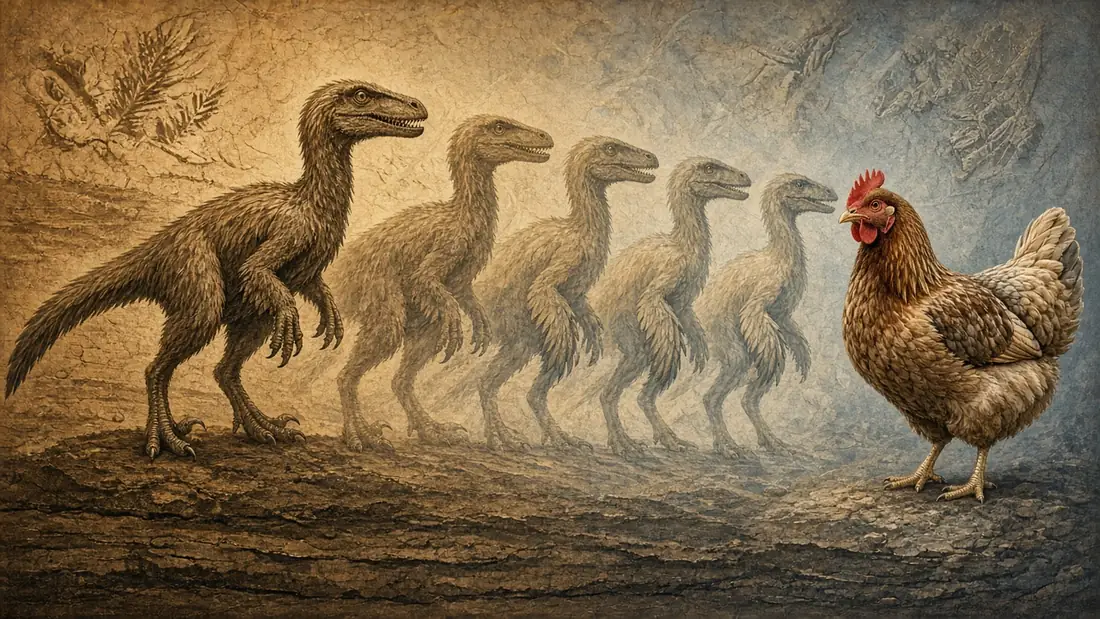
An illustration of a feathered theropod dinosaur transitioning across five stages into a modern hen.

Birds are not descended from dinosaurs — birds are dinosaurs, the one theropod lineage that survived the end-Cretaceous extinction.

Origins

Your breakfast has a 150-million-year pedigree

Every hen in every back garden is a living theropod. When researchers recovered collagen fragments from a 68-million-year-old Tyrannosaurus rex femur in 2007, the protein sequence they assembled turned out to match chicken more closely than any other living animal in the comparison set.

The domestic chicken itself is far younger. It descends primarily from the red junglefowl of South-East Asia, a shy forest bird that still roosts in trees and lays perhaps a dozen eggs a year. Selective breeding turned that into a bird that lays over 300.

  • Red junglefowlGallus gallus, the wild ancestor, first kept near rice-farming settlements roughly 3,500 years ago.
  • Hollow bones and air sacs — inherited straight from theropods, which is why a chicken skeleton is startlingly light in the hand.
  • The scaly feet — chicken legs are covered in the same beta-keratin scutes you would have found on a Velociraptor.
  • Sitting on eggs — brooding behaviour is visible in the fossil record, with Oviraptor specimens preserved mid-incubation over their own clutches.
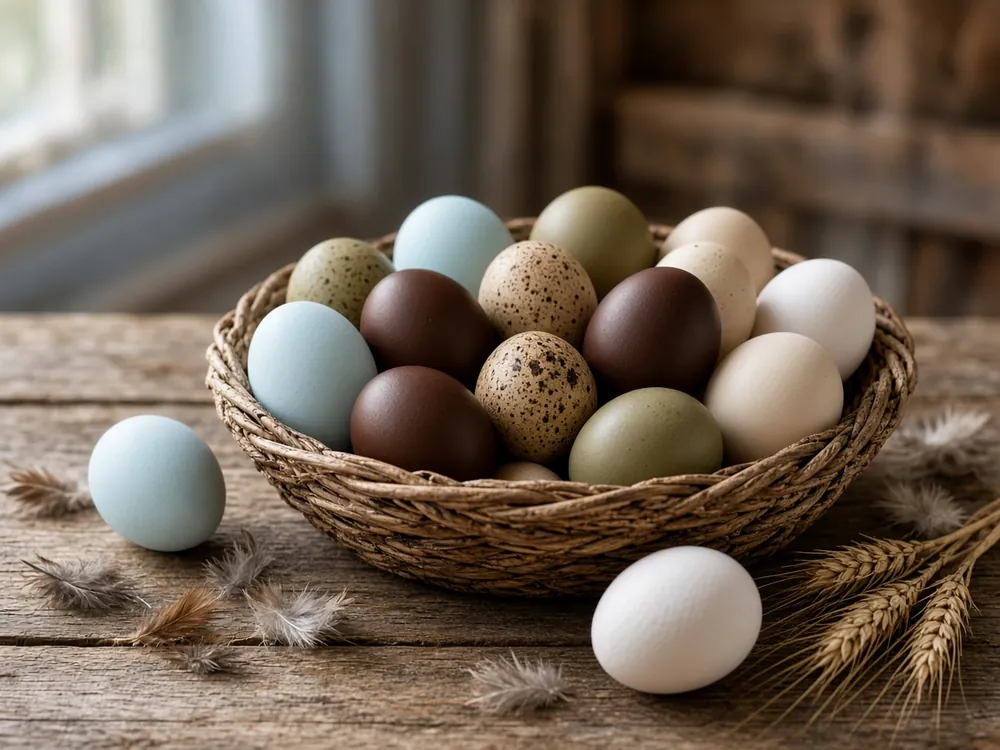
A woven basket of chicken eggs in pale blue, olive, speckled, chocolate brown, cream and white.

Blue from biliverdin, brown from protoporphyrin, olive when a hen inherits both. None of it changes the taste.

The egg files

A 26-hour manufacturing line, run daily

An egg is assembled in sequence, and the schedule barely varies. The yolk is released and fertilisation is possible for about fifteen minutes. The white is layered on over roughly three hours. Then the shell — some five grams of calcium carbonate — is deposited over the next twenty, crystal by crystal, in the dark.

Pigment arrives last. Blue-shell breeds lay down biliverdin all the way through, so the inside of an Araucana shell is blue too. Brown-shell breeds paint protoporphyrin onto the surface at the very end, which is why you can sometimes scrub a Marans egg slightly paler.

  • An egg is laid blunt-end first in about 95% of cases, and the hen usually announces it with a loud post-lay cackle.
  • The shell has ~7,000 pores, which is how a developing embryo breathes — and how a stored egg slowly loses moisture.
  • Yolk colour is diet, not quality. Marigold petals, maize and grass raise carotenoid levels; a pale yolk means a wheat-heavy ration, not a sick hen.
  • The record for yolks in a single egg is nine, a fluke of a young hen's ovulation timing rather than anything genetic.
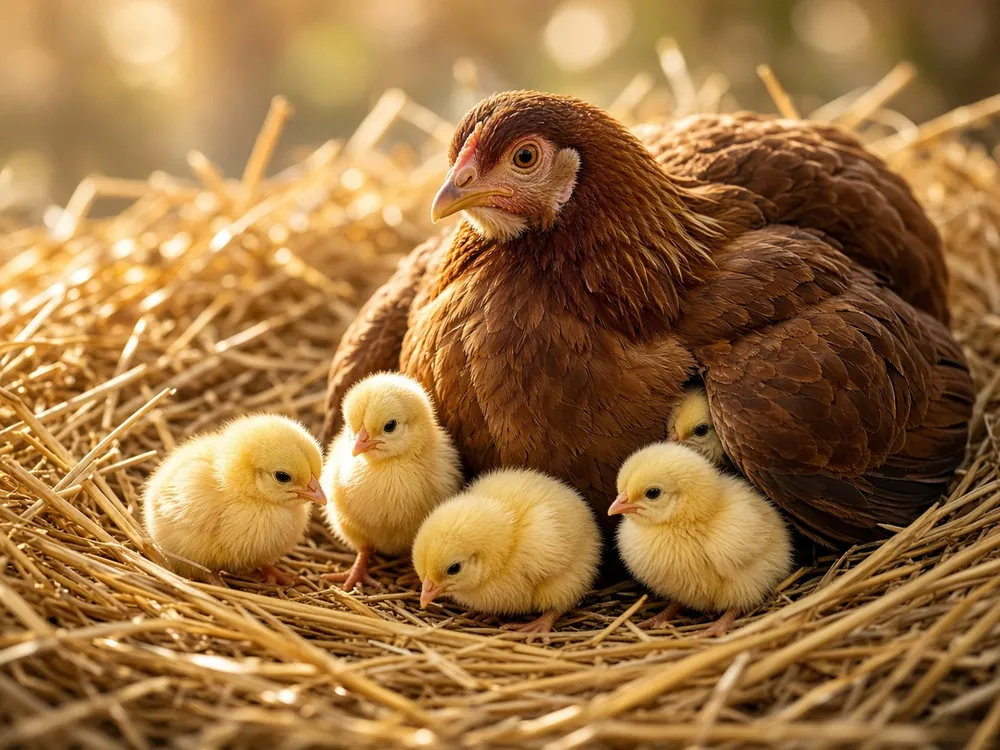
A brown mother hen sitting in golden straw surrounded by five fluffy yellow chicks.

Chicken, the language

They start talking before they hatch

In the last days of incubation, a chick begins clicking and peeping inside its shell, and the hen answers with a low purr. The conversation does real work: it synchronises the clutch so siblings hatch within hours of each other, and it teaches the chick its mother's voice before it has ever seen her.

After hatching, the vocabulary expands fast. Chickens keep two entirely separate alarm calls — a high, drawn-out whistle for a hawk overhead, and a sharp repeated cluck for a fox on the ground. Flockmates respond differently to each: crouch and look up, or stand tall and look sideways.

A rooster who finds food will pick it up, drop it, and call — a display called tidbitting. If no hen is watching, he mostly just eats it.
Referential communication in Gallus gallus

Breed cabinet

One species, 1,600 registered varieties

From a bird that fits in a coat pocket to one that stands nearly a metre tall — all of them the same species, all of them able to interbreed.

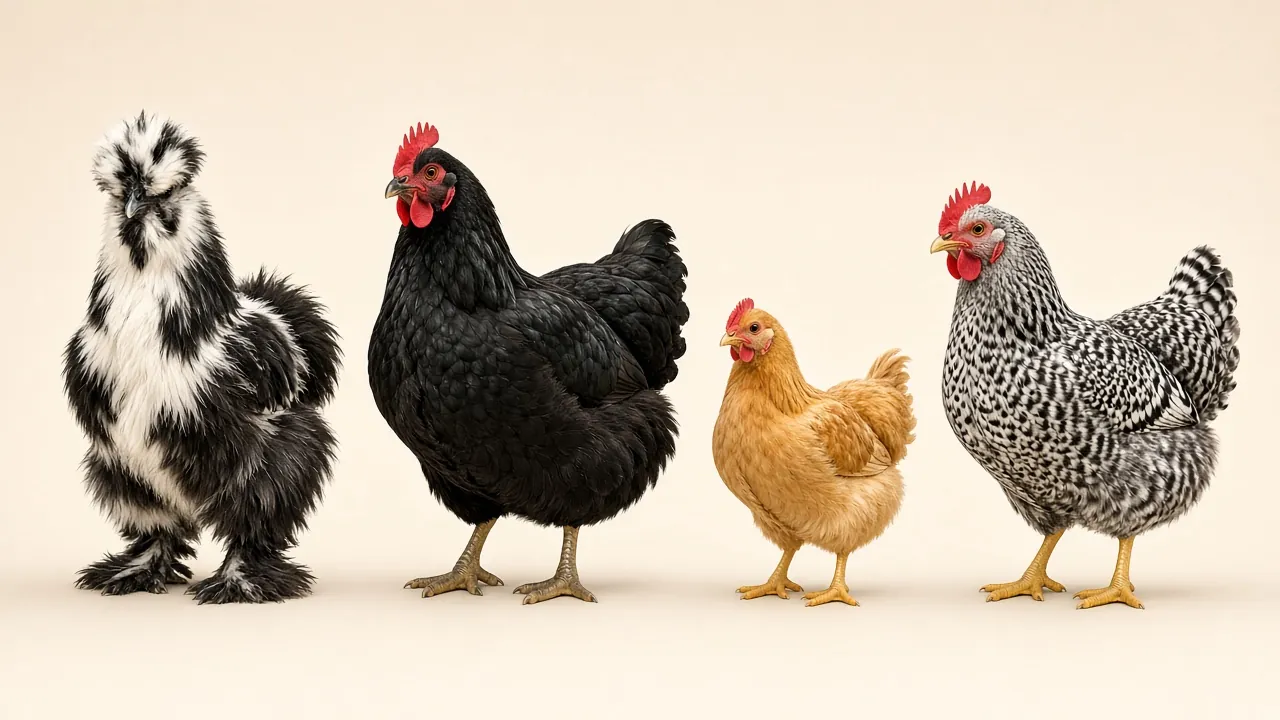
Four chicken breeds side by side: a fluffy black and white Silkie, a large black Jersey Giant, a small golden bantam and a barred Plymouth Rock.
Ornamental · China

Silkie

Feathers without functional barbs, so the plumage behaves like fur and the bird cannot fly. Also has black skin, black bones and five toes instead of four. Marco Polo wrote about them in the 13th century.

Heavyweight · New Jersey

Jersey Giant

The largest purebred chicken, bred in the 1880s to replace the turkey on American tables. Roosters reach 6 kg and take a slow eight to nine months to mature — which is precisely why the turkey kept its job.

Layer · Chile

Araucana

Lays genuinely blue eggs thanks to a retrovirus that inserted itself into the genome centuries ago and switched on biliverdin deposition. Many are also rumpless and carry ear tufts.

Layer · France

Marans

Famous for shells so dark they look varnished, graded by breeders on a nine-point colour scale. The pigment sits on the outside, so the first egg of a clutch is always the darkest.

Dual purpose · Massachusetts

Plymouth Rock

The barred grey-and-white pattern comes from a single dominant gene that interrupts pigment deposition as each feather grows. Calm, cold-hardy and the backbone of American backyard flocks since 1869.

Bantam · Japan

Serama

The smallest chicken in the world at roughly 250 grams — lighter than a large mango. Stands with its chest thrust forward and its wings pointed straight down at the ground.

Our game · Chapter one

Chicken Road

One hen. Sixty lanes of countryside traffic. One button.

We built Chicken Road because the oldest joke in the English language never actually explains the hard part. Getting to the other side is a timing problem, and timing problems make good arcade games.

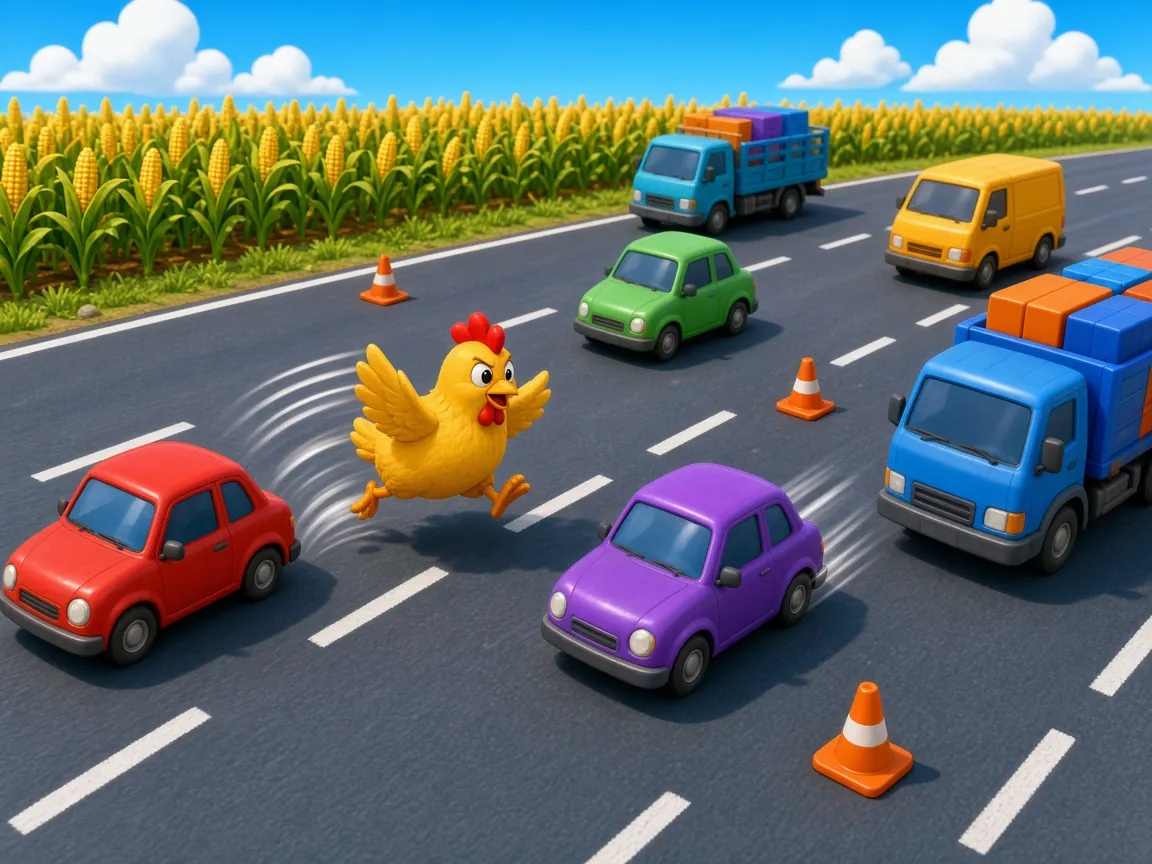
You play Henrietta, a Plymouth Rock hen with somewhere to be. Tap to hop forward one lane. That is the entire control scheme. Everything else — the grain trucks that brake unpredictably, the tractor that never yields, the puddle that hides a pothole — is the game learning how patient you are.

Chicken Road key art: a cartoon hen dashing between colourful cars on a four-lane highway beside a cornfield. Concept art
Feature 01

One-tap, zero tutorial

No twin sticks, no swipe gestures, no settings screen to survive. A first-time player is moving within two seconds of the title card.

Feature 02

Honest hitboxes

Henrietta's collision box is exactly the size of Henrietta. Every death is readable, which is the only reason a hard game stays fun.

Feature 03

Ghost replays

Your best run is recorded as a translucent hen that runs alongside you next time. Beating yourself is more motivating than a leaderboard.

Feature 04

Plays without a signal

The whole thing is under four megabytes and runs offline. Designed for a bus, a queue, or a farm with two bars of reception.

Four rules, learned in four seconds

  1. Tap to hop

    One tap moves Henrietta forward exactly one lane. Hold nothing, aim nothing. Release the tap to stay put and let a truck pass.

  2. Read the shoulder, not the car

    Every vehicle telegraphs its speed with a dust plume on the road shoulder. Long plume, fast car. Watch the ground and you will stop dying.

  3. Collect corn, but only if it is free

    Corn kernels sit deliberately in dangerous lanes. They buy cosmetic hens, nothing more — never trade a run for a kernel.

  4. The far verge is a checkpoint

    Reach the grass on the far side and the lanes reset harder and faster. Sixty lanes in, the traffic is no longer pretending to be fair.

Three ways to play

Mode

Sunrise Sprint

Ninety seconds, empty road, generous timing. The mode we hand people who say they do not play games.

Mode

Rush Hour

All sixty lanes, full traffic density, one life. The intended experience and the reason the game exists.

Mode

Endless Verge

Procedurally generated lanes that never stop widening. Our internal record is 412 crossings and we would love to lose it.

Free to play No purchases No wagering Ages 3+

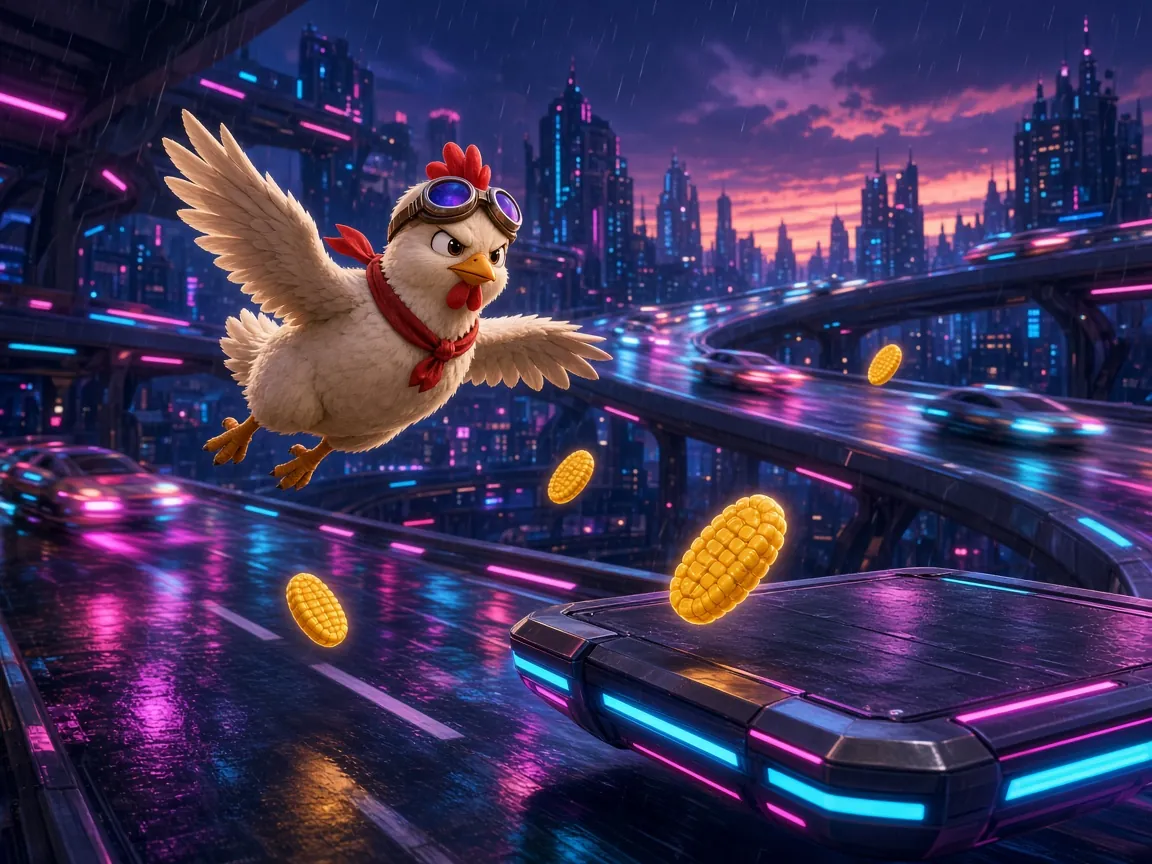
Chicken Road 2 key art: a hen wearing aviator goggles and a red scarf gliding over a neon-lit multi-level city highway in the rain.

Our game · Chapter two

Chicken Road 2

The road went vertical. So did Henrietta.

The countryside highway is behind her. Chicken Road 2 drops Henrietta into Coop City — nine stacked levels of neon overpass, permanent drizzle, and hover-traffic that does not use lanes so much as suggest them.

The single new verb is glide. Hold the tap at the apex of a hop and Henrietta spreads her wings, catching enough air to cross a gap no hen has any business crossing. She still cannot fly. She can now fall with style, on purpose, for about 1.4 seconds.

New mechanic

Feather-glide

Hold at the top of a hop to glide 1.4 seconds. Landing on a moving platform mid-glide chains into a boost — the skill ceiling of the whole game lives in that window.

New mechanic

Nine-level city

Overpasses stack vertically. Fall off level six and you do not die, you land on level five — and now you have to climb back up through traffic you already beat.

New mechanic

Live weather

Rain shortens braking distances and lengthens glides. Fog hides the far verge. Wind pushes you two lanes sideways mid-air. The forecast rotates every real-world hour.

Together

Two-hen co-op

A second player joins on the same screen as Clementine. One hen can block a lane while the other crosses — the only officially sanctioned way to use a friend as a traffic cone.

Daily

The 6 a.m. commute

One fixed seed, shared worldwide, replaced every morning. Everyone gets the same traffic, one attempt, and the same forty-second window to regret it.

Accessibility

Built to be finishable

Colour-blind-safe traffic palettes, a slow-motion assist toggle, remappable single-switch input, and full narration of every menu. No mode is hidden behind difficulty.

Chicken Road vs Chicken Road 2 — what actually changed
Feature Chicken Road Chicken Road 2
Core verb Hop Hop + hold-to-glide
World One flat countryside highway, 60 lanes Coop City, nine stacked levels of overpass
Failure state Instant — back to the verge Layered — you fall a level and climb back
Players Solo Solo or two-player local co-op
Environment Fixed clear weather Rain, fog and crosswind on an hourly rotation
Session length 20–90 seconds 2–6 minutes
Best for A queue, a lift, a bus stop An evening and a competitive housemate
Cost Free · no purchases · no wagering Free · no purchases · no wagering

A note on honesty: Chicken Road and Chicken Road 2 are original arcade concepts written and illustrated by the Cluckology team as editorial features. They are design pieces, not products on sale — there is no download, no purchase, no account and no gambling mechanic anywhere on this site. See our terms for the full wording.

Myth or fact

Four claims about chickens. Which ones survive?

Pick an answer and we will tell you what the research says. No score, no sign-up — nothing is stored.

A chicken can live for days without its head.

Chickens can recognise individual human faces.

Brown eggs are more nutritious than white ones.

Chickens experience something like empathy.

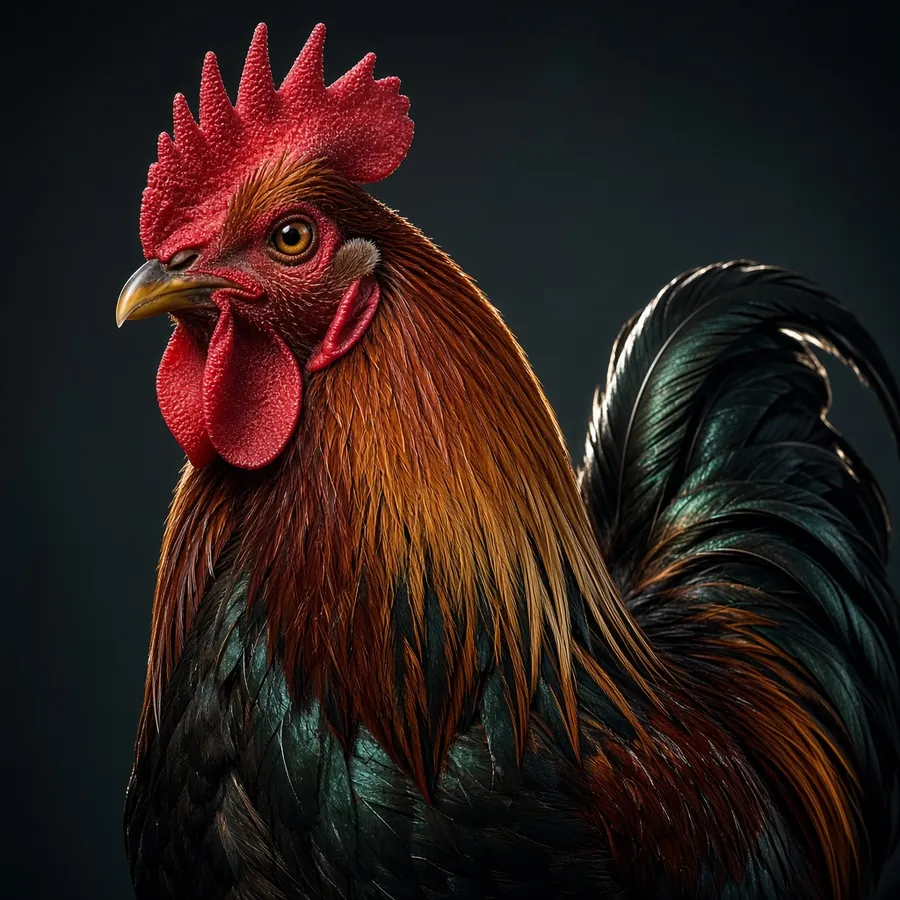
A studio portrait of a rooster in profile with copper neck feathers, iridescent green-black plumage and a bright red comb.

Anatomy

The comb is a radiator

Chickens do not sweat. With no glands in the skin, every bit of surplus heat has to leave through the respiratory tract or through bare skin — which is what the comb and wattles are for. They are dense with blood vessels sitting close to the air, and on a hot afternoon a bird can shed a meaningful share of its heat load through them.

That also explains geography. Breeds developed in Mediterranean heat carry enormous floppy combs; breeds from Canada and northern Europe have small, tight cushion combs that resist frostbite. The same organ, tuned in opposite directions by climate.

The colour is not decoration either. A pale, shrunken comb is one of the first visible signs that a hen has stopped laying or is unwell, which is why keepers check it before anything else.
Questions

Frequently asked

How many sounds can a chicken actually make?
Researchers have catalogued roughly thirty distinct vocalisations, including separate alarm calls for aerial and ground predators, a food call, a nesting call, a post-lay cackle, and the low purring a broody hen uses with her eggs. Several of them are referential — they carry information about a specific thing in the world, not just an emotional state.
Why are some chicken eggs blue or dark brown?
Two pigments do all of the work. Biliverdin is deposited throughout the shell as it forms and produces blue and green shells in breeds such as the Araucana. Protoporphyrin is applied to the outside in the final hours and produces the brown-to-chocolate shells of a Marans. A hen that inherits both lays olive. None of it affects nutrition or flavour.
Are chickens really related to dinosaurs?
Yes, and more directly than most people expect. Birds are surviving theropod dinosaurs rather than distant relatives of them. Protein fragments recovered from Tyrannosaurus rex fossils in 2007 matched chicken collagen more closely than that of any other living animal in the study.
Is Chicken Road a real game I can download?
No — and we would rather say so plainly. Chicken Road and Chicken Road 2 are original arcade concepts created and illustrated by Cluckology as editorial features. They are not available as downloadable products, they contain no wagering, loot boxes or real-money mechanics, and no page on this site will ever ask you to pay for them.
Does Cluckology cost anything to read?
No. Every article is free, with no account and no paywall. The site is funded by clearly labelled display advertising, including Google advertising products. We do not run ads styled to look like editorial content, and advertisers have no input on what we publish.
How do you handle my data and cookies?
Advertising and analytics cookies stay switched off until you accept them — we run Google Consent Mode with all advertising and analytics storage denied by default. You can review the detail in our privacy policy and cookie policy, and change your choice at any time with the cookie settings link.
Can I reuse your text or illustrations?
Short quotations with a link back are welcome. The illustrations and game artwork are ours and are not licensed for redistribution — write to hello@trafficstacklynx.net if you need permission and we will usually say yes.

The weekly cluck

One chicken fact a week. Nothing else.

A single short email every Thursday: one piece of research, one breed, and whatever we have broken in Chicken Road 2 that week. No sponsorships in the body copy, and one click to leave.

We store your address only to send this newsletter. Read the privacy policy. This demonstration form does not transmit data anywhere yet.